The "Garbage In" Crisis: Why Most AI Apps Fail (And How to Fix It)
1/9/20262 min read
We are living in the "Gold Rush" of Artificial Intelligence. Every day, a new startup launches a wrapper around GPT-4, and every enterprise announces an "AI Initiative." The demos look incredible. The promises are massive.
But there is a dirty secret in our industry right now: Most of these applications are failing in production.
We’ve all seen them. The customer support chatbot that hallucinates policy details. The internal search tool that retrieves documents from 2019 instead of 2024. The "smart" dashboard that gives you generic, actionable advice.
The problem usually isn’t the model. OpenAI, Anthropic, and Google have given us models that are smart enough to pass the Bar Exam.
The problem is the data. Or, more specifically, the lack of forensic rigor applied to that data before it hits the model.
The "Magic Box" Fallacy
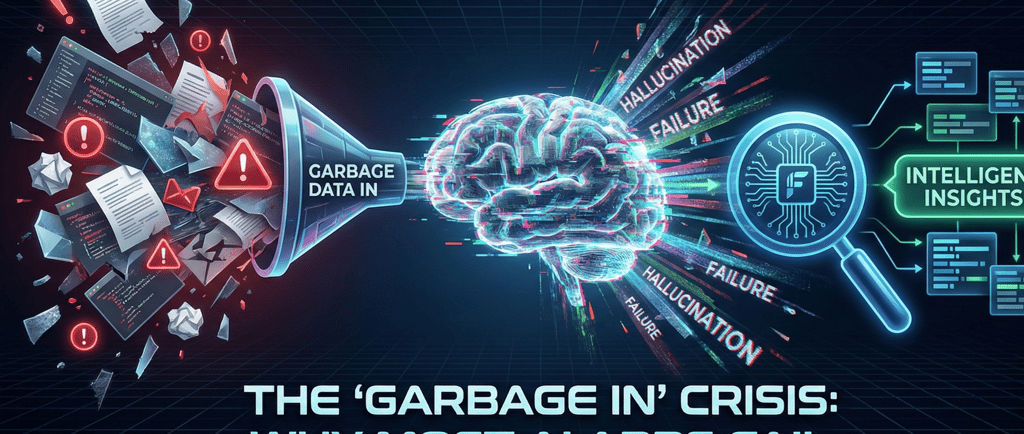
Many companies treat AI as a magic box. They throw messy, unstructured, duplicate, or contradictory data into a Vector Database and expect the AI to figure it out.
In computer science, we have an old saying: "Garbage In, Garbage Out" (GIGO).
In the age of Generative AI, this has evolved into something more dangerous: "Garbage In, Hallucination Out."
If you feed an LLM ambiguous data, it won’t crash. It won’t throw an error code. It will simply lie to you, confidently and convincingly. That is why AI development requires a fundamentally different approach than traditional software development.
Why "Data Forensics" Matters
This is why we founded DataForensics.io. We realized that building an "AI App" isn't just about React components or Python scripts. It is about Context Engineering.
Before we write a single line of code for a client, we treat their data ecosystem like a crime scene. We investigate it.
The Evidence (Data Audit): Is your data actually ready for retrieval? A PDF designed for human eyes is often terrible for a machine. We strip, clean, and restructure data so it is machine-legible.
The Chain of Custody (Pipeline Architecture): How does new data get into the system? If your AI doesn't know about the sale you made five minutes ago, it's already obsolete. Real-time data synchronization is the difference between a "toy" and a tool.
The Context (RAG Optimization): Retrieval-Augmented Generation (RAG) is the art of fetching the right data. Most developers use "naive RAG" (grabbing the most similar text). We use "semantic RAG" (grabbing the most relevant concepts).
Software That Actually Thinks
We are experienced software engineers. We have spent years building robust, scalable systems. We know that adding AI to an app introduces a layer of non-deterministic chaos.
Taming that chaos requires discipline. It requires forensic precision.
If you are looking to build a Web or Mobile application, you have a choice. You can hire a standard dev shop that will connect an API and wish you luck. Or, you can partner with engineers who understand that intelligence depends on data.
Don't just build an app. Build an asset.
Are you ready to investigate your potential?
At DataForensics.io, we bridge the gap between raw data and intelligent execution.